Earth Not A Globe, Chapter XIV:
Tangential HorizonAnother example of collimation being misunderstood by the author. By design, the horizontal cross hair of a theodolite lines up with anything
on the same level as the theodolites line of sight. So, when the horizon appears below the horizontal cross hair, that's because it
is lower than the line of sight through the theodolite, not because of "collimation". Granted, this in itself is not conclusive, but I really wanted to address the latter part of this section, which relates to the observations made by Alfred Wallace on the Bedford Level (yep, that one again!).
The illustration and description from ENaG:
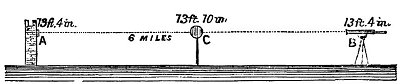
A, the signal on the Old Bedford Bridge; B, the telescope on Welney Bridge; and C, the central signal-post, three miles from each end. The object-glass of the telescope was 4½ inches diameter; hence the centre, or true eye-line, was 2¼ inches higher than the top of the signal B, and 3¾ inches below the top of the signal-disc at C. On directing the telescope, "with a power of 50," towards the signal A, the centre of which was 2¼ inches below the centre of the telescope, it was seen to be below it; but the disc on the centre pole, the top of which was, to begin with, 3¾ inches above the centre, or line of sight, from the telescope, was seen to stand considerably higher than the signal A. From which, three of the gentlemen immediately, but most unwarrantably, concluded that the elevation of the disc in the field of view of the telescope was owing to a rise in the water of the canal, showing convexity! whereas it was nothing more than simply the upward divergence (of that which was already 3¾ inches above the line of sight) produced by the magnifying power of the telescope, as shown in the experiment with the lens, on page 267, fig. 92.
Ignoring the assumption that the telescope was not aligned so that the centre of it's objective lens was at the same 13 feet 4 inches height as the top of the 'signal' and the centre of the disc, there is still a glaring fault in the author's reasoning. The top of the disc may have been 3¾ inches above the eye line of the telescope, which could have made the
top appear higher, but with the
bottom of the disc being 8¼ inches
below the eye line of the telescope, the same reasoning would place the
bottom of the disc
substantially lower than the 'signal' on the bridge. Here is an illustration of what was actually seen through the telescope:

The top disc in this image was the one set at 13 feet 4 inches, the lower disc was actually 4 feet below it, which gives a line of sight from the telescope to the 'signal' on the other bridge about 5 to 6 feet lower at the 'signal post' than it would be on a flat earth. That's pretty conclusive I think!